Telescopes of the Lick Observatory
UCO home > Public Information > Telescopes > Great Lick 36-inch Refractor
The Great Lick Refractor
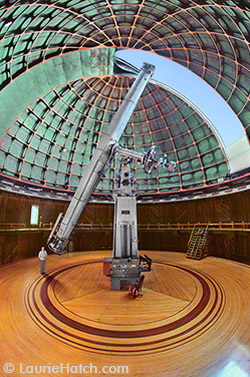
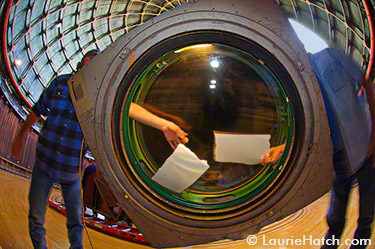 Lick Observatory was built during the years 1880 through 1888. The 36-inch refractor was fabricated at the same time, and one of the two original domes was built specifically for this telescope. Located in the larger dome of the main observatory building, the Great Lick refractor is 57 feet long, 4 feet in diameter, and weighs over 25,000 lbs. "36-inch" refers to the diameter of the two refracting lenses on the skyward end of the telescope. The photo on the left shows the cleaning of these lenses, a delicate maintenance procedure that few are allowed to witness. In this procedure, the end of the telescope that is usually pointed towards the sky must be brought down to the dome floor by repositioning the counterbalances that hold the telescope in its working position. This repositioning must be done carefully due to the mass of the telescope and the fragility of the glass.
 The two 36-inch diameter glass disks were fabricated in France, and ground and polished into lenses in Massachussetts by Alvan Clark and his son Alvan G. Clark. Transportation of these large and fragile glass lenses was a considerable challenge in the 1800s. The glass disks came from France to Boston by ship. After grinding and polishing, they traveled across the country by railroad. Finally they came up the winding road from San Jose to Mt. Hamilton by horse and carriage. One of the original lenses broke in transit. I took several years and 18 attempts to fabricate the replacement lens, which finally arrived on Mt. Hamilton in 1886.
When completed, the Lick Refractor was the largest refracting telescope in the world. Even today, it is second in size only to the 40-inch Yerkes Observatory refractor.
James Lick's Legacy
Eccentric businessman and real estate magnate James Lick donated the $700,000 needed to build a "telescope superior to and more powerful than any telescope yet made." A self-made millionaire bachelor with a fondness for monuments, as Lick approached old age he wanted his name and reputation to live on after his death. He had several ideas about how to build his memorial for posterity. First he considered constructing statues of himself and his parents on the California coast. No minor undertaking, these statues were to have been large enough to be seen from ships at sea! Advisors pointed out that such statues would be likely targets for shelling during any future wars. So Lick's second idea was to build a huge pyramid, larger than the Great Pyramid of Cheops, on 4th and Market Streets in San Francisco.
 Finally, Lick's scientific acquaintances influenced him to commission a project that was monumental not just in physical size, but in its ability to further scientific research and give astronomers a better look at the Universe. And so began the world's largest and most powerful telescope.
Lick Observatory was the first permanently occupied observatory in the world to be built on a mountaintop. James Lick considered several locations for the telescope. He chose Mt. Hamilton partly because he could see it from his home, being infirm and unable to travel. At the time, observatories were typically built in cities. It was speculated that placing an observatory at a higher elevation might eliminate some atmospheric interference, allowing for better observing. This proved to be correct, and Lick Observatory's success set the trend towards building observatories on mountaintops rather than in cities.
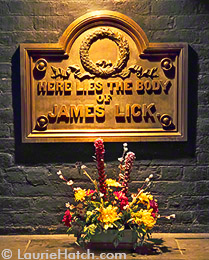
Sadly, James Lick died before the Great Lick Refractor and Lick Observatory were completed. His body is interred at the base of the Refractor, marked with a bronze plaque to honor the man and his vision.
Lick Refractor in Action: Yesterday & Today
The Great Lick refractor was a premier research telescope for nearly a century. In 1892, E.E. Barnard discovered Jupiter's fifth moon using this telescope. This discovery astonished the world because two centuries had passed since Galileo discovered Jupiter's first four moons. People of the time took for granted that Galileo had discovered all of Jupiter's moons. Jupiter is now known to have at least 50 true moons.

Numerous photographs were produced with this telescope throughout the years using astronomical photographic plates consisting of plate glass coated with photographic emulsion. A selection of photographic prints from these plates is available in the Lick Observatory Gift Shop or by mailorder from the Publications Office. The lunar photo series above was taken with the Lick Refractor during the 1930s. This series is still used throughout the world in science textbooks and online classes to illustrate lunar phases.
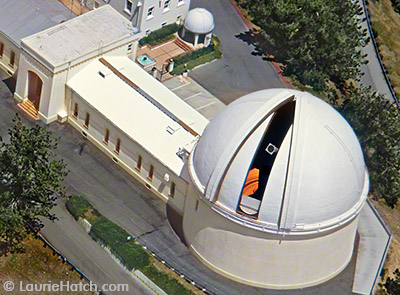 Mt. Hamilton photographer Laurie Hatch captured the photo to the right through the dome opening of the 36-inch Great Lick Refractor. Note the lens end of the telescope in the dome slit is the lens that is being cleaned in the image above. The dome is not usually open during the day, since most observations take place at night. However, on November 15, 1999, the Great Refractor followed the transit of planet Mercury across the face of the sun. A CCD camera was attached to the telescope, and a streaming video feed linked the camera to the Exploratorium in San Francisco. Exploratorium visitors watched this rare event as if they were inside the 36-inch dome on Mt. Hamilton.
Although primarily of historical interest, the Lick Refractor is still used infrequently for research. Currently it is used to observe the separation and orbits of binary stars. It is often used as a teaching telescope for university and college astronomy classes as well as for NASA teachers workshops. The general public may view the heavens through the 36-inch refractor at the Lick Observatory Summer Visitors Program and Music of the Spheres concert series.
Daytime visitors to Mt. Hamilton are invited to look at the Great Lick Refractor and hear an informal Lick Observatory history talk whenever the main building is open. Please check in at the Gift Shop to participate. Tours are given approximately every half-hour during business hours, at no charge.
To learn more about the building of Lick Observatory and the life of James Lick, visit the Lick Observatory history pages.